ORPHANS IN THE STORM
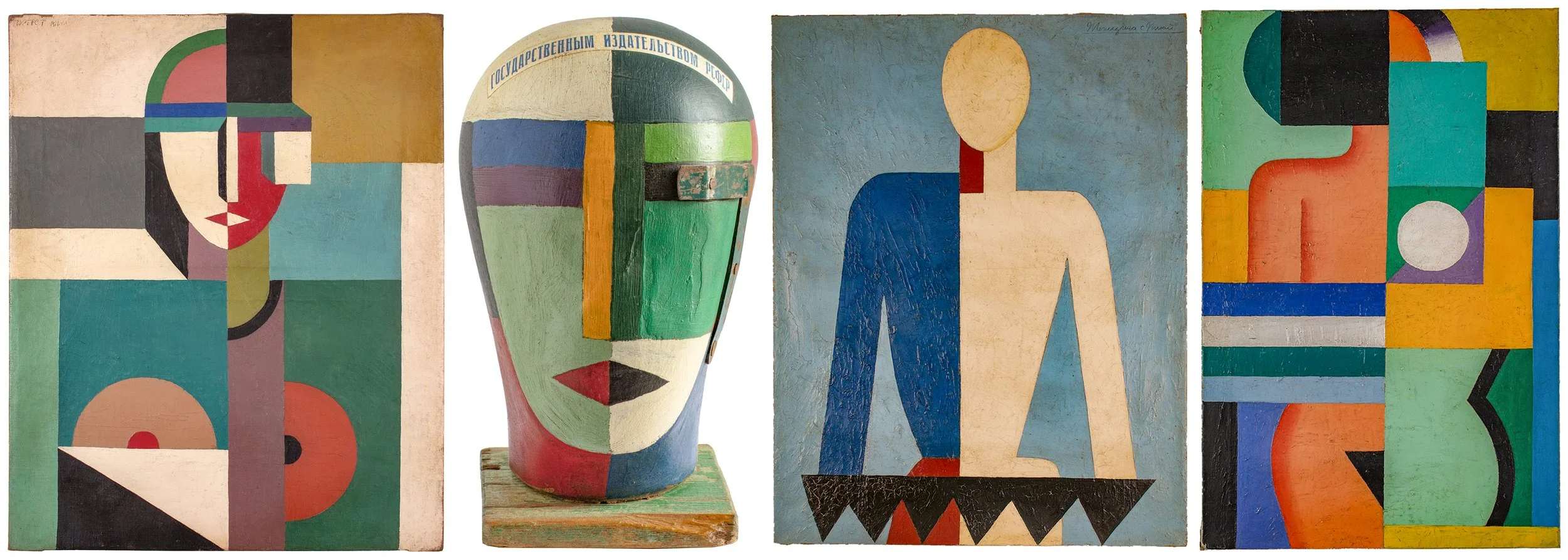
“So art, as chic theory, may be disembodied ideas. Art, as narrative history, may be remote from the present and a lie. Artworks themselves, however, are orphans in the storm, permanent practical precedents, forever young, forever free, and physically here with us. Theoretical constructs may hold their place in a field of knowledge. Historical artifacts may speak of their ancestry and parental origins. Works of art as orphans in the storm are ready to be adopted, nurtured, and groomed to the needs of any astonishing new circumstance.” — Dave Hickey, Pirates and Farmers, 2013.
In the 1982 film Blade Runner, four escaped androids, known as replicants, return to Earth in a renegade act of defiance against their creator, bioengineer Eldon Tyrell. The Tyrell Corporation produces advanced human-like robots to perform duties in deep space that no human could survive; their company slogan is "More human than human."
My brother and I sat facing the eminent scholar of Russian avant-garde art, Rupert Jenkins. Unbeknownst to me, my brother had been in contact with Professor Jenkins in the hope that the professor would accept our collection of 181 orphaned Russian avant-garde paintings for scholarly investigation and possible authentication.
I’d warned my brother that the project of getting the collection taken seriously would best be accomplished if we engineered situations that would bring people to us. I’d spent enough time in the art world to know that the worst thing you can do is appear needy, and that reaching out to people like Jenkins would likely yield no results, and could, in the worst case, cause reputational harm.
A few years earlier, a friend who thought he could net himself a handsome commission by getting the paintings authenticated and sold connected me with a New York-based art authentication specialist. What resulted was a trip down an insane rabbit hole of duplicity and grift as she attempted a catch-and-kill operation to neutralize the collection. Her final assessment was that the works were nothing more than a bunch of clever forgeries produced in the 1970s by Russian Jews fleeing Soviet oppression. In her words, "These works were produced to be used as a form of currency for their new lives in the West". When I told her that, if it were the case, that these beautiful works played a role in helping an oppressed people prosper in their new homeland, it would be a wonderful history for these orphaned works. She immediately shut down that conversation. Before we parted ways, I asked her if, in her forty-year career, she'd ever discovered an authentic work. Without hesitation, she replied, "Never."
As it turns out, the attorney who gave us the art authenticator's contact information was the same attorney who helped Jeffrey Epstein and Leon Black structure high-stakes financial transactions with Cézanne's and Monet's. So when my brother told me he'd arranged a meeting with Jenkins, a person who I knew, was well aware of the existence of our collection of the art world version of radioactive waste, I had to assume that it was highly likely that he had no interest in our discovery, and would, like, the New York art authenticator, try to fuck or sandbag us.
The arduous project of building the collection into a force to be reckoned with began ten years earlier, with a series of investigations into the artworks' provenance. The story the German seller told us was that he'd purchased the works in our collection in the mid-1990s at an auction of unclaimed Russian freight in Berlin. Because this type of art was illegal to own or even discuss in the former totalitarian state, and given the chaotic dissolution of the Soviet Union, his story seemed plausible, but probably unprovable. That said, the low price we'd paid for the works raised red flags that the artworks could be stolen.
We'd taken three of the paintings to a couple of highly qualified art conservators for examination; both confirmed our suspicions that the paintings were authentic period works. Later, a forensic handwriting analyst concluded that an inscription on one of the paintings was a "dead match" for the artist Kasimir Malevich. We hired an appraiser, hoping that she, using research techniques unavailable to us, could provide some answers. All she did was provide us with a report estimating the value of 30 paintings at fifty million dollars. She, like the conservators, was convinced of their authenticity.
My brother and I settled into the chairs opposite Rupert Jenkins, a thin British professor in his seventies. He was cordial—at ease and quietly authoritative. We were meeting in his rarefied private-university office, encircled by a vast trove of Soviet books and ephemera.
I took a book of high-resolution images of our collection and slid it across the table. He smiled as he leafed through the book.
Through a dystopian haze of smog and neon, two 800-story Tyrell Corporation megastructures loom over the Los Angeles of 2019. In the executive suite, Eldon Tyrell’s newest and most sophisticated replicant, Rachael, meets Decker, a bounty hunter tasked with “retiring” rogue replicants. Rachael asks, “It seems you think our (replicants) work is not a benefit to the public?” Decker responds, "They're like any other machine; they're either a benefit or a hazard. If they're a benefit, it's not my problem."
A few years ago, after viewing my film, I Found Malevich, a Dutch scholar gave me his thoughts about our collection; in the movie, there’s a clip of a replica of one of the works in our collection burning in a barren desert. “I have watched your film extensively,” he wrote, “and agree with your cinematic conclusion at the end that it was better to burn all of the works due to lack of evidence of any authenticity.”
As Jenkins leafed through the book, my brother chimed in, “Do you think they’re real?” Jenkins looked up, “Of course not, they’re all forgeries.” My brother is an intelligent person; he’d spent twenty years as an officer in the Air Force, and accomplished some remarkable things. His exposure to the personality types that often inhabit academia and the art world was sparse at best.
I knew that Jenkins was lying. “Wow,” I said, “That’s really interesting. If they’re all fake, who do you think made them?” An expert with a PhD, he had to answer, “There are villages in Russia where such things are produced en masse. It’s a sort of cottage industry.” “That’s amazing,” I said, “Have you ever visited one of the villages?” “No,” he snapped back. When I told him how fantastic it was that he’d determined that the paintings were fake. He looked at me, puzzled, “Why is that good news?” I told him that if the paintings were authentic, we’d probably be setting ourselves up for a bunch of legal problems, or possibly worse. I explained how conservators, handwriting analysts, appraisers, even the museum director, where we exhibited the collection, went on our local public radio station and said that he was convinced that some of the works were “painted by the masters.” “This is great news,” I said, “We have you, the premier expert in the field, rendering your decision that they’re all fake. What a great exhibit. A collection of master forgeries, people love forgeries.”
Renegade replicants are a threat to corporations like Tyrell. Clever and unencumbered by conscience, with strength that seems without limit, they endanger the established order. That’s why Eldon Tyrell hired the bounty hunter Rick Decker to take down Roy, Pris, Zhora, and Leon, the band of replicants, whose only wish was for Tyrell to extend their pre-programmed four-year life span.
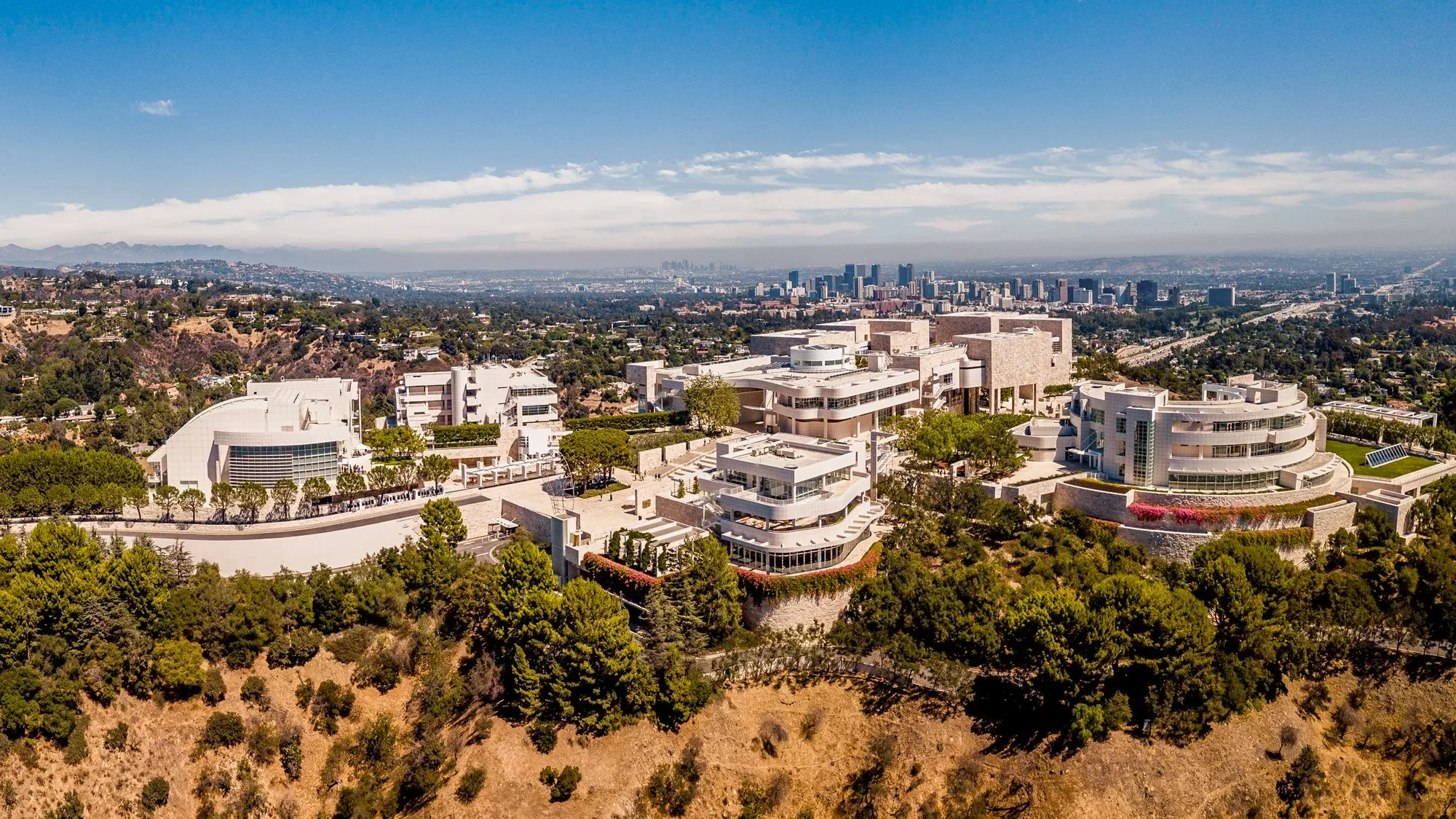
The Getty Center, Los Angeles, California.
Jenkins leaned back, “I think you should have another exhibit, but not at a small museum. I think you should exhibit the collection at a large museum.” “I’m game,” I said. Maybe my brother was on the right track in connecting with Jenkins. Then Jenkins began laying out his plan, “I’d like to propose the idea to the Getty. I’ve bequeathed my archives to the Research Institute; perhaps they could take it on.” His offer was way beyond anything that either of us had considered possible. His plan grew more elaborate: “Perhaps we could ask outside institutions to loan authentic works by some of the artists in your collection and do a side-by-side comparison.” That prospect seemed improbable; works by Malevich and Rodchenko are valued in the tens of millions of dollars, and many of the more obscure artists represented in our collection are either in Russian museums or private collections. His proposal was starting to seem far-fetched. “We could have a panel discussion. You and Angus Culpepper could debate the authenticity of your artworks.” Angus Culpepper is the nemesis of all collectors of these orphaned artworks. He’s a posh, off-putting British dealer who, for some unknown reason, has become the go-to expert on the authenticity of avant-garde artworks. Over the years, he’s made all sorts of outrageous claims about the massive numbers of forgeries in the avant-garde market. He’s gone so far as to claim that 99% of all Soviet avant-garde art is fake.
“I don’t want to debate Culpepper; he’s a clown,” I said. Jenkins offered an alternate plan, “If the Getty doesn’t bite, perhaps you could have an exhibit in Russia. I’m a close personal friend with the director of the Russian State Museum; she might entertain exhibiting your collection.”
Zhora was the first replicant taken down by the bounty hunter, Decker. Her elimination was violent and terrifying. As she fled, Decker pumped her full of bullets. Her translucent raincoat splattered in blooms of blood. Her desire to live became a crushing truth as she smashed through an obstacle course of street merchants and retail display windows while trying to escape.
Jenkins' offer seemed like a game, trying to one-up my earlier comment that the collection would be better off if all the works were fake. "Rupert," I said, "You know, if we send our collection to Russia, they'll never come back." “Well,” he said, "Then at least you'll know they're real."
Finally, all of the cards were on the table. "You know Putin?” I asked. Jenkins had been awarded the Russian Medal of Friendship by Putin's proxy, then-President Dmitri Medvedev. "Yes," Jenkins beamed, "Vladimir is a wonderful man.” The Russian military had invaded Ukraine and seized Crimea a year earlier. "What do you think about Ukraine?" I asked. "Ukraine is Russia." He spat back.
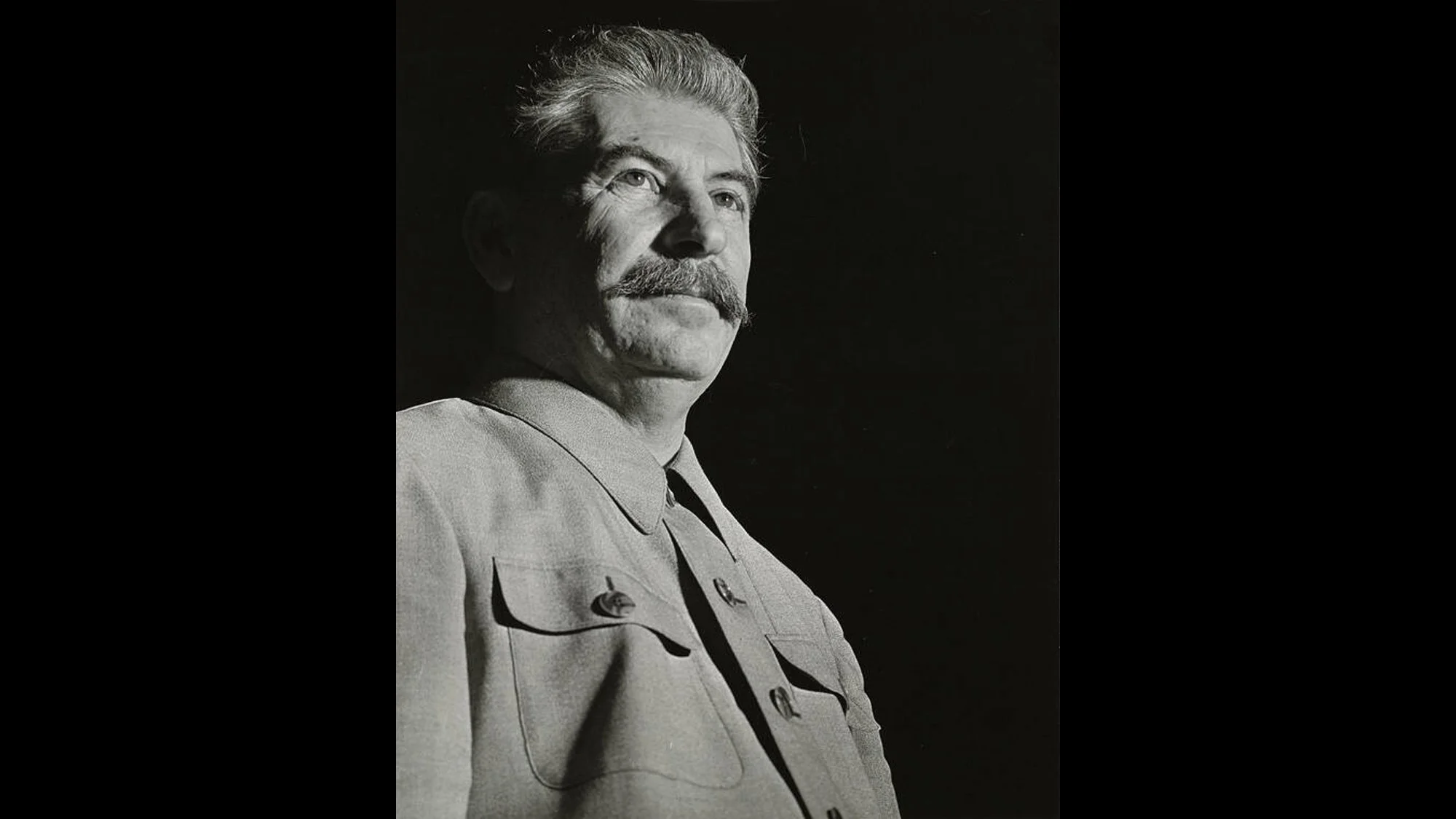
Joseph Stalin.
As we were leaving Jenkins's office, I noticed a large, full-length portrait of Joseph Stalin hanging on the wall above a filthy Mr. Coffee machine. "Nice picture of Stalin," I commented. A gleam filled Jenkins's eyes as he looked up to the towering dictator, "Isn't he magnificent!”
Stalin and his henchmen snuffed out this art movement that Jenkins had built his career on, killing, imprisoning, and exiling many of these artists. Acting under direct orders from Stalin, the Soviet government threw these artworks into dark storage, in an attempt to erase Russia’s collective memory of a time when art sought to fuse with politics, with the hope of creating a better world.
Stalin's project, like that of Eldon Tyrell, was an attempt to create useful automatons, controlling every aspect of their subjects' lives from birth to death. Tyrell appealed to Roy as he neared the end of his pre-determined life cycle, "The light that burns twice as bright burns half as long. And you have burned so very, very brightly, Roy." The statement may as well be what the once promising young romantic poet Stalin may have said to these artists, whom he called "Cloud Dwellers,” right before he signed their death sentences.
After eliminating three replicants, Decker’s left to face the strongest and most cunning of the bunch, Roy, whose strength and will to live are magnitudes beyond Decker’s ability to defend against. Locked in a life and death struggle on the roof of a building, Roy heaves Decker into the abyss, only to grab his hand at the last moment.
Roy is dying. Using his last bit of strength, Roy pulls his would-be assassin to safety and, in his dying breath, gives Decker the gift of his memories, "I've seen things you people wouldn't believe—attack ships on fire off the shoulder of Orion. I watched C-beams glitter in the dark near the Tannhäuser Gate. All those moments will be lost in time, like tears in rain."
Roy's final words call to mind a message that was sent to me by a Russian artist, and follower of the Instagram account for this collection —
"I hope you are safe and this beautiful art is safe too. You did a great job and now this art influences people and artists all around the world. I just hope you are not at risk.
For me it is very touching also because of the history of my country. As well as the whole humanity of course. As I feel these bright colors and forms hide artists souls suffering from great tension in a totalitarian state. Like a manifest of freedom hidden in a silent scream. And also for some artists like a dream of a new better world.”
I understand that this essay might be read as a screed against people I perceive to have done me wrong, people who, from my, perhaps skewed, vantage point, have failed to live up to their stated professional responsibilities.
After meeting with Professor Jenkins, I sat down and wrote an essay titled "Art of the Zero Category," the name given to art with no value in the former Soviet Union. In the essay, I attempted to tell the truth as I've experienced it; I mention Professor Jenkins, changing his name, with the promise of a possible appointment at the Getty. I sent the essay to Professor Jenkins. I thought it would only be fair to let the Professor have the final word. So, here’s his reply after reading my essay:
Dear Ron,
Thanks for your letter and for the essay, a Romantic confession. Perhaps one day someone will write the history of Russian fakes not only of the AG, but also of 19th century Realism (all the so called Aivazovskys, Levitans and Shishkins) and now of the "non-conformists" (1960s-80s). What a jungle! In some sense you are lucky to be alive. By the way, Basner (link) is now free of house arrest, although she may not travel abroad.
Viewed from a wider perspective, in perhaps a hundred years' time your paintings will become "real" in the sense that Roman copies of Greek statues have become "masterworks". In a thousand years' time the difference between 1910 and 2010 will seem irrelevant -- so time is on your side!
Kind regards, Dr. Rupert Jenkins, PhD.
Wait, what am I thinking? I'm not handing the mic to a man who can turn contempt into scholarship and call it insight. The essay I wrote, which he called "a romantic confession," was my attempt to reveal the corrupt systems that suppress not only this art but culture in general. The works in this collection may be Russian, Ukrainian, Finnish, and Hungarian, and who knows what other nationalities were drawn to the artistic dynamism in post-revolutionary Russia. This art was produced in teaching schools that were open to the public, where any citizen who felt inspired could explore the promise of a utopian future.
The path of historic and intellectual destruction that I outlined in my essay, Art of the Zero Category, which Jenkins feigned dismissal of, was my attempt to outline the path of destruction, of which he is a cog. Pull a thread on his sweater, and you'll find a strand that leads all the way to the top: fellow sycophantic academics, politicians, and billionaires; it’s the same thread that runs through every aspect of our society these days.
The saving grace of these artworks is the gift of their voice; they are not replicants. They are permanent and practical precedents. They are forever young. They are forever free. And they are physically here with us. They are Orphans in our storm.